PISTOL

A gun is a firearm that can be fired with one hand

SNIPER

Sniper, or sniper shooter, is an infantryman who is specially trained to have the ability to kill enemies hidden from a distance using a rifle.

ASSAULT RIFLE

The term assault rifle (Assault Rifle) is a translation of the German word Sturmgewehr (weapon literature for invading position)

SUBMACHINE GUN

A submachine gun (SMG) is an automatic carbine, designed to fire pistol cartridges. It combines the automatic fire of a machine gun with the cartridge of a pistol.

GRANAT

Hand grenades, hand grenades, or pineapple grenades are bombs that are grasped and thrown by hand.

BAZOOKA

RPG-7 or Bazooka was first introduced by the Soviet Union in 1961 and used at the team level. The initial concept of this weapon is made based on weapons of World War II era, namely Bazoka USA and Germany Panzerfaust.

Tampilkan postingan dengan label Assault. Tampilkan semua postingan

Jumat, 15 September 2017

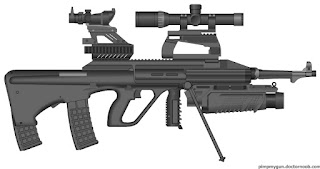
Steyr Aug

Steyr AUG is a series of rifles that were first introduced in 1977 by the Austrian arms company Steyr Mannlicher. AUG stands for Armee Universal Gewehr, which means "Universal Army Rifle". Steyr AUG's own name is more often used to refer to specific versions, namely the 5.56 mm NATO bullpup assault rifle variant, with green color and an integrated telescope. This rifle actually has many variants, ranging from submachine guns, sniper rifles, to light machine guns. This rifle has been adopted into the main arms of the Austrian armed forces, Australia, New Zealand, Luxembourg, Ireland, and also was used by Malaysia. The Indonesian Special Police Unit (Gegana Brimob Polri) also uses Steyr AUG.

Design
The AUG is one of the first rifles to use the bullpup design, which makes it 25% shorter than other long-barreled rifles, without sacrificing performance and accuracy. Most AUG variants are equipped with integrated 1.5x telescopic shots. AUG is considered to have a modern ergonomic design. Other features such as the ability used by right-handed and left-handed shooters, and the use of transparent plastic materials.

The Steyr AUG barrel can be switched easily, for example to the carbine barrel or to a longer barrel. Even AUG has a modified device that can turn it into a submachine gun. Other variants, such as light machine-gun variants that have a heavier barrel, can not be modified and are set from the factory.


Variants


 -Steyr AUG A1 - The standard version introduced in 1977. Initially it was only green with a 20-inch barrel.
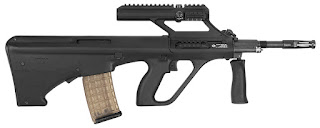
-Steyr AUG A2 - Similar to A2, but the viewfinder can be removed and replaced with picatinny rail.
-
Steyr AUG A3 - It's been heavily modified. It has integrated picatinny rails on the top and sides. Use 6.8 mm Remington SPC bullet.
-
Steyr AUG P- AUG A1 with shorter barrel.
-
Steyr AUG P Special receiver- AUG P with picatinny rail.
-
Steyr AUG 9 mm (AUG SMG / AUG Para) - AUG modified to use 9 x 19 mm bullets.
-
Steyr AUG M203 - AUG modified to use M203 grenade launcher.
-
Steyr AUG LSW (Light Support Weapon) - AUG as a light support weapon.
-
Steyr AUG HBAR (Heavy-Barreled Automatic Rifle) - AUG with longer and heavy barrel, closed bolt, as a light machine gun.
-
Steyr AUG LMG (Light Machine Gun) - Based on AUG HBAR, but with open bolt, and 4X viewfinder instead of 1.5x like a regular AUG.
-
Stey AUG LMG-T- Same with LMG, but with picatinny rail.
-
Steyr AUG HBAR-T- Sniper rifle based on HBAR.
-
Steyr AUG Z- AUG A2 semi-automatic version for the civil market.
-
Steyr USR- AUG A2 tailored for the US civilian market.
-
F88 Austeyr - AUG modified for Australia.
 

Karabin M4


Carbine M4, or M4 Carbine, is a short and light version of the M16 assault rifle. M4 carbine has 80% of the same parts as M16A2. M4 has a semi-automatic shot and three-point burst (same as M16A2), while M4A1 has a semi-automatic and automatic selection. M4A1 is also sometimes equipped with a heavier barrel, to withstand the heat generated from the automatic firing for a long time.

OutlineM4 and M4A1 use 5.56 x 45 mm NATO caliber bullets. Both are selective-fire rifles, which use a gas system, water-cooled, wearing a magazen box, and have a telescopic bar. These can be exchanged for regular butters, but they are rarely done in the United States military.
Like a carbine in general, M4 is more comfortable to carry than a long-barreled rifle. Besides ideal for use by non-infantry soldiers (such as vehicle drivers, aides, and staff officers), this also makes M4 suitable for close combat and special forces operations. M4 had become the standard for United States Special Operations Command (USSOCOM) and became the choice of US Army Special Forces. In 2006 Malaysia also purchased Karabin M4 to replace the Steyr AUG rifle.
M4 carbines were developed and manufactured for the United States Government by the Colt arms company, which contracted to produce the M4 carbine family until 2009. But in addition to Colt, a number of other weapon manufacturers also offer M4-like rifles. M4 and M16A4 have replaced M16 and M16A2 in US armed forces. M4 also replaces submachine gun M3A1 commonly used tank riders. M4 is almost similar to previous M16 compact version, that is XM177, the difference is M4 does not use bullet M193 / 6 ball.


 History and variants
In addition to the first shipment, all new M4 and M4A1 existing in the United States military are already using flat top tops equipped with standard M1913 or Picatinny rail railings, which are used to install a variety of viewfinder devices. The model numbers used by the United States military are Colt Model 920 (M4) and 921 (M4A1).


M4A1
M4A1 carbine is a modification of the M4 carbine, which is made for special forces. M4A1 is widely used in US special forces, such as Delta Force, Navy SEALS, and Force Reconnaissance. This rifle becomes the choice of special forces and anti-terrorist forces, due to its size and its ability to shoot full-automatic. These features are very useful for urban battles. Although the M4A1 does not have firing range as far as the M16 rifle, many military observers think that shooting targets above 300 meters without a special rifle is unnecessary. M4A1 is very effective at a distance of 150 meters.


SOPMOD Block IUSSOCOM developed Special IOP Special Operation (SOPMOD - Special Operations Peculiar Modification) Block I for use of troops under his leadership. This device includes, among others, the M4A1 carbine, the Knight's Armament Company's RIS (Rail Interface System) system, the M203 grenade launcher with its shot, KAC-made artificial sound silencer, KAC backup shot, laser pointer / infrra -made AN / PEQ-2A by Insight Technologies, Trijicon's ACOG and Reflex optical shots, and a night vision shoot. 
SOPMOD Block IIThe second-generation SOPMOD is being planned, with many companies competing to get their contracts. Some leading companies, together with their designs, are Knight's Armament Company with URX II, ARMS with Selective Integrated Rail (SIR) system, and Lewis Machine & Tool with Monolithic Rail Platform (MRP). 
Other variantsOther variants of the M4 carbine are also manufactured by other manufacturers, and used by special forces other than the United States, such as the Australian Special Air Service Regiment (SASR), Malaysian Police Special Forces Movement, and the Anti-Terror Detachment 88 Police. In addition, SAS UK uses also made Diemaco M4 named C8. Although Diemaco was finally purchased by Colt, and named Colt Canada, the names of the Diemaco rifle were unchanged.
 

AK 47


AK-47 (abbreviation Avtomat Kalashnikova 1947, Russia: Автомат Калашникова образца 1947 года) is an assault rifle designed by Mikhail Kalashnikov, produced by the Russian arms maker IZhMASh, and used by many Eastern Bloc countries during the Cold War. This rifle was adopted and used as a Soviet standard rifle in 1947.When compared to the rifles used during World War II, AK-47 has a smaller size, with a shorter range, using bullets with a smaller 7.62 x 39 mm caliber, and has a selective-fire option. The AK-47 is one of the first assault rifles and is by far the most widely produced assault rifle

Background designIn World War II, Germany created the concept of assault rifles. This concept is based on the experience that modern combat is more prevalent at a short distance of about 100 meters. The power and reach of the bullets at that time turned out to be too large. Thus, the Germans began to develop bullets and submachine guns (many magazen contents and can be full-automatic shot) with bullets that range up to 300 meters. Taking into account the cost of production, this was achieved by shortening a 7.92 x 57 mm Mauser bullet to a size of 33 mm ie 7.92 x 33 mm Kurz (Kurz means short).
The end result, Sturmgewehr 44 (StG44), is not the first rifle to use this concept; previously Italy and the Soviet Union had designed a similar concept. However, Germany was the first to mass-produce their rifles. The Germans used many of their new rifles to confront the Soviets on the Eastern Front. The Soviet experience against Germany influenced Soviet doctrine in the following years.
Under Soviet doctrine, Mikhail Kalashnikov began thinking of the design of his rifle since the hospital, after being wounded in battle at Bryansk. He was informed that a new weapon was being searched, to be used with a 7.62 x 41 mm bullet made by Elisarov and Semin in 1943. But that time, Kalashnikov's design was defeated against Sudayev's design, PPS43. Kalashnikov changed his first design after he studied StG44 Germany in 1946. Because his design was quite impressive, Kalashnikov was chosen to lead a design team.


Design concept
Although similar, Mikhail Kalashnikov denies that the design was made based on the German StG44. AK-47 is more accurately described as a mixture of innovations in previous years. For example, the AK-47 mechanics are more like M1 Garand than German rifles. Double locking lugs, unlocking raceway, and similar American design-like trigger mechanisms.This is a natural thing, given that millions of M1 Garand have been successfully used in all corners of the globe. Although mechanically similar to M1 Garand, the concept of bullets, component layouts, gas systems, and AK-47 assembly methods are clearly similar to StG44.

The AK-47's genius is, that the design is most appropriate for mass production. So the AK-47 managed to combine the benefits of M1 Garand with StG44, and could be produced quickly by the Soviet Union at the time.


The development of the receiverInitially the production of the receiver (the part of the rifle that contains the firing mechanism) encountered many problems. The first production model used a receiver made of metal sheet metal stamping. The problem encountered was the difficulty of welding railing guides and ejectors, which eventually led to a lot of resistance. But this problem did not stop production, as a solution, the metal stamping receiver was replaced with a machined receiver (shaped with a special machine tool). This process is indeed more expensive, but fortunately the necessary tools and workers are already available, previously used for Mosin-Nagant production. Due to these problems, the Soviet Union was able to distribute these rifles extensively in 1956. At the same time, the production of AK-47 precursor rifles, SKS, continued.
After the production problem was successfully completed, in 1959 a new draft was formulated and named AKM (M for modernization-in Russian: Автомат Калашникова Модернизированный). [8] The new model uses a metal stamping receiver and features a muzzle break at the end of the barrel, to reduce the kick. Additionally, a hammer hammer (hammer for bullet hammer) is added to allow the shotgun to shoot well in full-automatic shot options. The new model is lighter than the initial model, about two-thirds the initial weight.The majority of Kalashnikov's rifle production outside Russia, licensed or unlicensed, uses this AKM model, because of the ease of making a stamping receiver. This model is the most widely encountered and produced worldwide. However, almost all Kalashnikov-made rifles commonly called AK-47s, this is a misnomer, because the AK-47s are only rifles that use the earliest three receiver models. The picture on the side shows the difference between an AK-47 Type 2 receiver machined, with a Type 4 AKM stamping receiver, such as a screw rather than a weld, and a small dimple difference over magazen.


FeaturesAK-47 is a simple rifle, not expensive to produce, and easy to clean and maintain. Its durability and
reliability are famous legendary.The large gas pistons, the flexibility of the spaces on the mechanical parts, and the design of the bullets, make the AK-47 shoot smoothly even if the inside components are filled with dirt or foreign matter. But this reliability slightly compromises accuracy, since great tolerance to the mechanical part does not guarantee the accuracy and consistency of more accurate rifles.
AK-47 rear shots can be adjusted, with the distance setting of the difference of each 100 meters. The front shots can also be set setting elevasinya on the field. And the horizontal setting is set in the armory before it is given to the wearer. The standard shooting setting is set to place a few centimeters above or below the targeted point, at a distance of 250 meters. A "point-blank" setting like this is used so that the shooter does not need to change the settings of the viewfinder at close range. This setting is the same as that used for Mosin-Nagant and SKS, to facilitate transition and training.
Hallways and bullet chambers, as well as gas pistons and interior cylinders of regular AK-47 gas are lined with chrome. This greatly helps extend the life of these tools, as it prevents corrosion and rust. And this is very important, since ammunition in the 20th century often contains a corrosive mercury element, which requires regular cleaning to prevent damage. The chrome plating of the important parts of the rifle is now common in modern weapons.